These classic Italian pignoli cookies are one of those bakery-style treats that look elegant but come together with a surprisingly short ingredient list. Almond paste gives the centers their rich, almost marzipan-like flavor, while confectioners’ sugar keeps the texture tender and pleasantly chewy. A generous coating of pine nuts adds a lightly toasted, buttery crunch that makes every bite feel special.
I especially like these around the holidays because they’re naturally small, pretty enough for a cookie tray, and sturdy enough for gifting. The dough is a little sticky, but lightly floured hands make shaping easy, and pressing the pine nuts gently into each cookie helps create that signature rustic Italian bakery appearance. My family always reaches for the nut-covered cookies first when I set out a mixed dessert platter.
They’re sweet without being overwhelmingly sugary, with crisp, golden edges and a soft almond center that gets even better once completely cooled.

Love this recipe? Pin it to your Holiday Cookies or Italian Desserts board on Pinterest so you don’t lose it!
Ingredients
Cookie Dough
12 oz almond paste, broken into pieces
½ cup granulated sugar
1 cup confectioners’ sugar
4 large egg whites, divided
Coating and Shaping
1½ cups pine nuts
All-purpose flour, for shaping
Cooking spray, for greasing
Instructions
- Heat the oven to 165°C / 325°F. Line two baking sheets with aluminum foil, then coat the foil lightly with cooking spray.
- Add the almond paste and granulated sugar to a food processor. Process until the mixture is finely blended and crumbly.
- Add the confectioners’ sugar and 2 egg whites. Process again until the dough becomes smooth and evenly combined.
- Whisk the remaining 2 egg whites in a small bowl until loosened. Spread the pine nuts in a shallow dish.
- Dust your hands lightly with flour. Portion the sticky dough and roll it into approximately 1-inch balls.
- Dip each ball lightly in the beaten egg whites, allowing the excess to drip away. Roll in the pine nuts and gently press so the nuts adhere.
- Arrange the cookies on the prepared baking sheets with space between them. Press each one gently into a round about 1½ inches wide.
- Bake at 165°C / 325°F for 15 to 18 minutes, or until the cookies are lightly golden around the edges.
- Allow the cookies to rest briefly on the baking sheets before carefully transferring them to a wire rack to cool completely.
Cooking Notes
Pignoli dough is naturally soft and sticky because almond paste contains both ground almonds and sugar. Use only enough flour on your hands to prevent sticking; incorporating too much flour into the dough can make the cookies firm.
Choose soft almond paste rather than almond filling. The two products are not interchangeable.
Do not soak the dough balls in egg white. A thin coating is enough to make the pine nuts adhere without making the cookies wet.
Press the pine nuts firmly but gently into the surface so they stay attached during baking.
The cookies are ready when the edges have developed a pale golden color. Avoid baking until deeply browned; overbaking can reduce their characteristic chewy texture.
For a gluten-free version, use gluten-free all-purpose flour only for dusting your hands. The flour is not otherwise part of the cookie dough.
Nutrition
The original recipe yields 36 cookies, or approximately 36 servings when 1 cookie is treated as a serving. Based on the provided nutrition information and the ingredient quantities, the finished batch is approximately 3 dozen small cookies, generally around 20 to 25 grams each after baking.
Estimated Nutrition per Serving
- Calories: 101 kcal
- Fat: 6.0 g
- Carb: 11.0 g
- Protein: 3.0 g
Recipe Science
Pignoli cookies are almond-based Italian cookies made primarily from almond paste, sugar, egg whites, and pine nuts. Unlike conventional cookies, they contain little to no flour in the actual dough. Almond paste supplies both fat and finely ground nut solids, while egg whites provide moisture and protein. Baking at a moderate 165°C / 325°F allows the cookies to set gradually while preserving their soft interior.
The combination of almond paste and sugar produces a dense, chewy structure rather than a cake-like crumb. Egg whites help bind the mixture without adding the additional fat found in whole eggs. The outer coating of pine nuts develops toasted flavors during the 15- to 18-minute baking period while providing textural contrast against the softer center.
These cookies work well for holiday baking because they can be prepared in batches and stored in an airtight container after cooling. If necessary, gluten-free flour can replace regular flour for shaping because the flour is used only as a handling aid.
Dietary Notes & Health Alerts: Based on the supplied nutrition values, one cookie contains approximately 7 mg sodium and 1 g saturated fat, both well below 20% of the FDA Daily Values of 2,300 mg sodium and 20 g saturated fat. Approximately 6 g of sugar per cookie is also below 20% of the 50 g Daily Value used for added sugars. No listed nutrient reaches the FDA-style “High” threshold per serving.
Why You’ll Love This Recipe
- Classic Italian Bakery Texture: A lightly crisp exterior gives way to a dense, tender, chewy almond center.
- Big Almond Flavor: Almond paste creates a much deeper almond taste than extract alone could provide.
- Naturally Simple Dough: The cookie base requires only almond paste, sugar, and egg whites.
- Perfect for Holiday Gifting: Pine nuts give these cookies an elegant finish that looks beautiful in cookie boxes.
- Easy Gluten-Free Adjustment: Simply use gluten-free flour when dusting your hands during shaping.
FAQ
- Why is my pignoli cookie dough so sticky?: That is normal. Almond paste and egg whites create a soft dough. Lightly flour your hands rather than adding flour directly to the mixture.
- Can I substitute marzipan for almond paste?: It is not recommended. Marzipan generally contains more sugar and can alter both the sweetness and texture.
- Why are my pine nuts falling off?: Make sure each dough ball receives a thin coating of egg white, then gently press the pine nuts into the surface before baking.
- Can I make these ahead of time?: Yes. Cool them completely, then store them in an airtight container. Their chewy texture makes them particularly well suited to advance holiday baking.
- Can I freeze pignoli cookies?: Yes. Freeze fully cooled cookies in an airtight container with parchment between layers, then thaw them at room temperature before serving.
Conclusion
These chewy Italian pignoli cookies are proof that a short ingredient list can still produce something wonderfully distinctive. Cooking and baking are always a little personal, so don’t hesitate to adjust the size or browning level until you find the version your family loves most.
What other Italian cookie would you put beside these on your holiday cookie tray? Happy baking from my kitchen to yours!
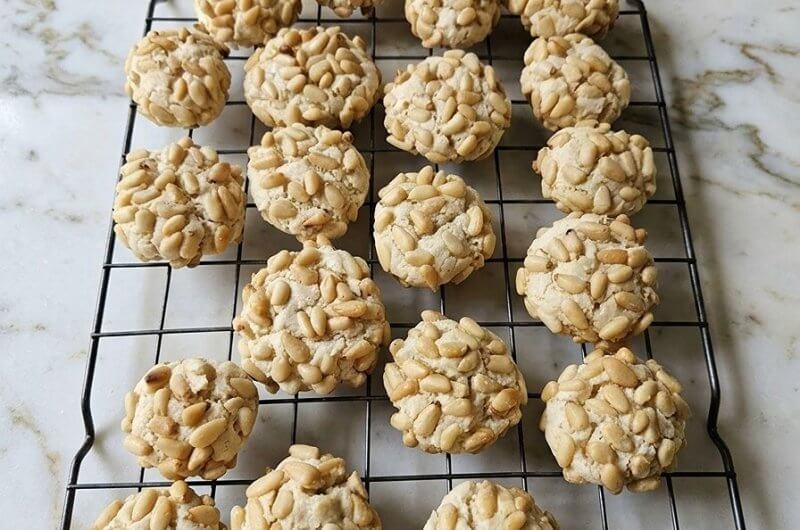
Classic Chewy Italian Pignoli Cookies
Course: International CookiesCuisine: ItalianDifficulty: Easy36
cookies30
minutes15
minutes101
kcalSoft, chewy almond cookies coated with buttery pine nuts and baked until lightly golden.
Ingredients
- Cookie Dough
12 oz almond paste, broken into pieces
½ cup granulated sugar
1 cup confectioners’ sugar
4 large egg whites, divided
- Coating and Shaping
1½ cups pine nuts
All-purpose flour, for shaping
Cooking spray, for greasing
Directions
- Heat the oven to 165°C / 325°F. Line two baking sheets with aluminum foil, then coat the foil lightly with cooking spray.
- Add the almond paste and granulated sugar to a food processor. Process until the mixture is finely blended and crumbly.
- Add the confectioners’ sugar and 2 egg whites. Process again until the dough becomes smooth and evenly combined.
- Whisk the remaining 2 egg whites in a small bowl until loosened. Spread the pine nuts in a shallow dish.
- Dust your hands lightly with flour. Portion the sticky dough and roll it into approximately 1-inch balls.
- Dip each ball lightly in the beaten egg whites, allowing the excess to drip away. Roll in the pine nuts and gently press so the nuts adhere.
- Arrange the cookies on the prepared baking sheets with space between them. Press each one gently into a round about 1½ inches wide.
- Bake at 165°C / 325°F for 15 to 18 minutes, or until the cookies are lightly golden around the edges.
- Allow the cookies to rest briefly on the baking sheets before carefully transferring them to a wire rack to cool completely.